PHOTO NEWS: Ahmadiyya Muslim Jama’at National Executive Officers’ meeting held at National Headquarters
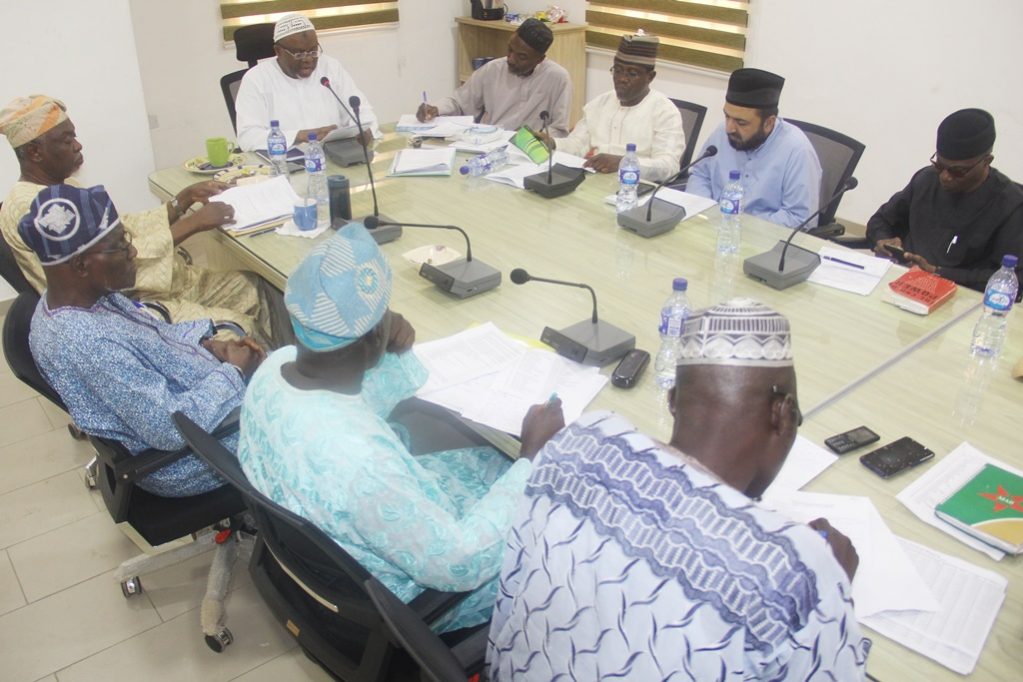
Ahmadiyya Muslim Jama’at National Executive Officers’ meeting held at National Headquarters, Ojokoro, Lagos on Saturday 5th October 2019.

Ahmadiyya Muslim Jama’at National Executive Officers’ meeting held at National Headquarters, Ojokoro, Lagos on Saturday 5th October 2019.
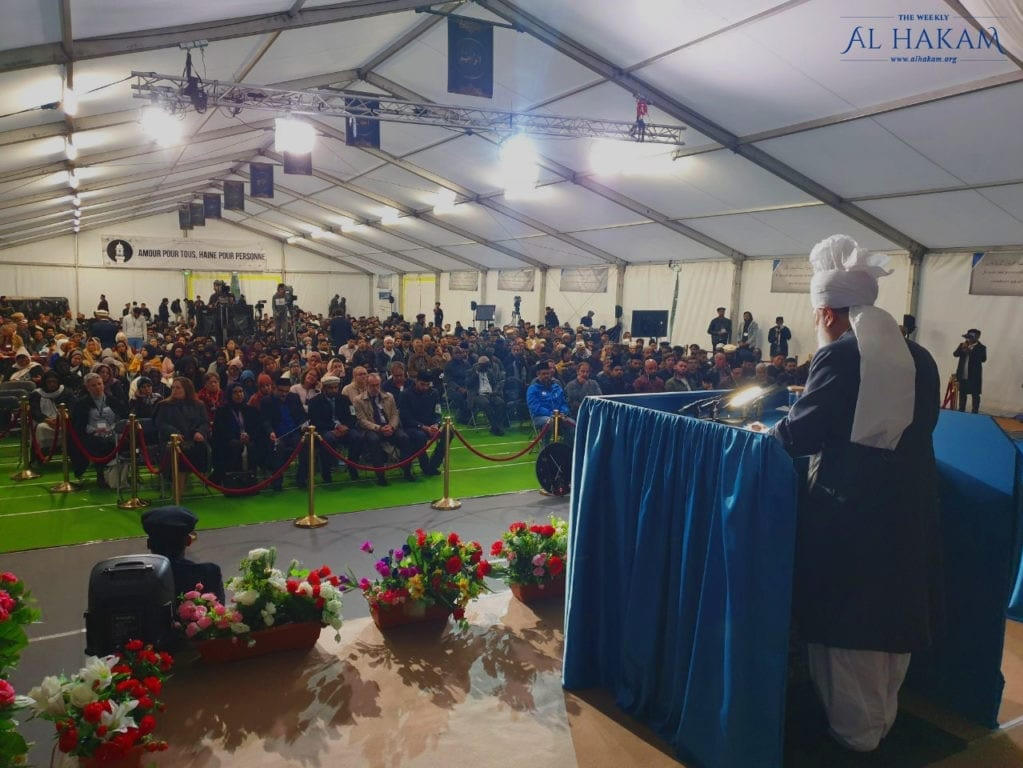
Trie-Chateau, France, Saturday, 05 October: Hazrat Khalifatul Masih V, may Allah be his Helper, addressed French dignitaries and guests at Jalsa Salana France at approximately 6:30 pm local time. The session started with the recitation of the Holy Quran by Sebastian Ataul Hayye Sahib who recited verse 14 of Surah al-Hujurat (chapter 49). He also presented the French translation of the verse. A brief introduction to the Jamaat was presented to the non-Ahmadi guests present. After, the Mayor of Trie-Chateau, David Didier addressed the Jalsa in which he said he was honoured to receive Hazrat Khlaifatul Masih Vaa in the little town of Trie-Chateau. The next speaker was Dr. Agnes De Foe, a Sociologist, who spoke before the Jalsa. Her brief speech encapsulated her interacting with Jamaat-e-Ahmadiyya and spoke highly of the message of peace that Hazrat Amirul Momineenaa is promoting. Dr. Katrin Langewiesche, an Anthropologist, spoke of her interacting with the Jamaat in Burkina Faso when the Jamaat was carrying out some charitable works. She also took the opportunity to present her book to Huzooraa, that includes a chapter on Islam Ahmadiyyat. Thereafter, Hazrat Khalifatul Masih Vaa addressed the congregation. After Tashahud, Ta‘awuz and the recitation of Surah al-Fatihah, Hazrat Amirul Momineenaa thanked the guests for joining the “purely religious function”. Huzooraa then condemned the atrocities and violent attacks that have also taken place in France by so-called Muslim extremists. Hazrat Amirul Momineenaa highlighted that Islam is a religion of peace and tolerance. “A true Muslim is a person who himself is a peaceful person” Huzooraa explained. The Islamic greeting itself portrays how Islam is a religion of peace. Even non-Muslims use this greeting. Thus, it cannot be that Islam teaches to meet others with peace and security and on the other hand, promotes hate and extremism. “All forms of extremism and violence are completely against Islamic teachings”, Huzooraa expressed. In order to truly understand the teachings of Islam, one must study the life of its Holy Founder, peace be upon him. Huzooraa laid out how inhumane injustices were carried out against Muslims. However, the Holy Prophetsa taught patience. The Holy Prophetsa called upon his followers to remain peaceful even if it costed their lives. The Holy Prophetsa and his companions endured this relentless pain and then migrated out of their city to escape this agony. However, the enemies of Islam continued to pursue them and cause pain to Muslims. Finally, Allah gave permission to fight in defence to safeguard religion. “Hence, when the Holy Prophetsa and his followers were forced to partake in wars and battles, it was for the sake of defending the rights of all people” including people of other faiths, Hazrat Amirul Momineenaa explained. If Islam wanted to spread its teachings with force, then why would the Holy Quran explicitly state that it was the duty of Muslims to safeguard all people and their rights? Hazrat Amirul Momineenaa exampled that early Muslims gave their life to uphold and establish the principles of “individual liberty, freedom of religion and freedom of belief”, which are the “corner stones of Islam.” Chapter 2 verse 257 of the Holy Quran encapsulates this freedom, Huzooraa explained. The Holy Prophetsa and the four Rightly Guided Caliphs never usurped rights of others. Rather they promoted freedom and peace. The Holy Prophetsa, after migrating to Medina, formed a treaty with the Jews of Medina. “The Muslims and the Jews pledged to cooperate and to be faithful citizens of the state” Huzooraa said. They were able to practice their religion and customs without the fear of sanctions or persecution. The Holy Prophetsa never deviated from this covenant. Islam has never permitted its followers to spread their faith “through the use of force”. The treaty of Medina enabled all people to practice their beliefs and traditions and were duty bound to be loyal citizens of the state and to refrain from all activities that would undermine the peace of the city. Keeping these aspects in mind, it is not accurate to attribute the deeds of a minority of Muslims who commit atrocities to the religion of Islam. Huzooraa said that “from cover to cover” the Holy Quran is replete with guidance that instruct Muslims to avail “every opportunity for attaining peace in the world.” Allah the Almighty instructed the Holy Prophetsa to convey the message of Islam and thereafter leave the matter to Allah. The Holy Quran never once advocated violence or force against those who shunned its teachings, rather “it called on Muslims to exhibit tolerance and patience” Hazrat Amirul Momineenaa said. Hazrat Amirul Momineenaa said that “Islam’s teachings are categorical that violent conquest or forceful conversion are strictly prohibited”. Any act or conduct that is detrimental to the peace of society is forbidden in Islam. The Holy Prophetsa taught that a true Muslim is he from whose tongue and hands, others are safe. The Holy Prophetsa made it clear that Muslims must protect and care for all members of society, irrespective of faith. Consequently, terrorists who commit suicide bombings, attack night clubs etc. are all guilty of violating the teachings of Islam. The Holy Quran has also given guiding principles of day-to-day life that promote peace. For example chapter 2 verse 189 of the Holy Quran promotes fair trade and upholding the integrity of all transactions. Allah instructs Muslims to acquire wealth in an honest and truthful manner, not being unjust. Chapter 83 verses 2-4, the Holy Quran condemns those who are exploitative in business transactions, try to short-change others while demanding more than their due, in return. Such people are cursed and will be disgraced. The Holy Quran has given guidance for internal conflicts as well. The Islamic focus is always in establishing sustainable peace. Hazrat Amirul Momineenaa referred to chapter 49, verse 10 of the Holy Quran that details how two conflicting parties or nations should be dealt with, in a just and peaceful manner. Huzooraa said that the verse captures a means of lasting peace, if acted on. However, regrettably, many Muslim nations fail to act upon this Quranic injunction. Today, we observe that cruelty and injustices are perpetrated by dominant powers in the name of

Trie-Chateau, France, Sunday, 06 October: The 27th Jalsa Salana France concludes with Bai‘at and the final address of Hazrat Khalifatul Masih V, may Allah be his Helper. The Bai‘at ceremony at the 27th Jalsa Salana France took place at approximately 3:15 local time. Huzooraa then led the congregation in Zuhr and Asr prayers. The concluding session was initiated with the recitation of the Holy Quran, verses 13-20 of Surah Luqman (chapter 31), followed by their Urdu translation by Mansoor Ahmad Sahib. The verses captured Hazrat Luqman’sas guidance to his son; shunning shirk, being thankful, praying and adopting good morals. An Arabic poem written by the Promised Messiah, peace be upon him, was then read out by an Arab Ahmadi, Hamza Sahib. The couplets were translated by Usama Ahmad Sahib. The poem was in praise of Allah the Almighty. An Urdu poem written by the Promised Messiahas was then read out by Matlub Ahmad Sahib. Next, Hazrat Amirul Momineenaa presented awards of academic excellence to more than 35 members. Thereafter, Hazrat Khalifatul Masih Vaa addressed the congregation. After Tashahud, Ta‘awuz and the recitation of Surah al-Fatihah, Hazrat Amirul Momineenaa recited verse 22 of Surah al-Mujadalah from the Holy Quran followed by its translation. The translation of the verse is “Allah has decreed: ‘Most surely I will prevail, I and My Messengers.’ Verily, Allah is Powerful, Mighty.” Hazrat Amirul Momineenaa explained that prophets have to endure great hardships when they are raised by Allah. It seems as the prophets will be defeated by enemies, but Allah grants them ultimate success. Huzooraa said that the verse he recited points towards this victory. The Holy Prophet, peace and blessings of Allah be upon him, went through this as well. His enemies thought they would destroy the weak Muslims but the complete opposite happened. Then, Allah sent the Promised Messiah, peace be upon him, and gave him great promises of success and victory. Allah continuously told the Promised Messiahas that he would come out successful despite enemies from all sides. On numerous occasions, the Promised Messiahas received the revelation, “Allah has decreed: ‘Most surely I will prevail, I and My Messengers.’” The Promised Messiahas said that God, from the outset, has written and has made it His practice that He and His prophet shall be victorious. In a similar vein, the Promised Messiahas came as the second coming of the Holy Prophetsa. In Noah’s Ark the Promised Messiahas asks if people think that enemies will stop the prophet of Allah i.e himself. The answer is that it is not possible and “Allah has decreed: ‘Most surely I will prevail, I and my Messengers.’” At an occasion, the Promised Messiahas said that the one who is from Allah can never go to waste. And that Allah grants victory to His prophets. The meaning of “victory” is to establish the message and truthfulness of Allah in the earth. Prophets come to sow the seed; this is the “victory” that is followed by a second manifestation that cultivates the seed sowed by the prophet. This second manifestation of Khilafat can be observed through the success of Jamaat-e-Ahmadiyya. Huzooraa said that the message that was given from a small hamlet is now echoing throughout the world. The history of Jamaat-e-Ahmadiyya bears witness to the promise of Allah that His Prophet will prosper. Hazrat Amirul Momineenaa expressed that he would relate incidents on how Allah has and is fulfilling this promise. A gentlemen from Cameroon phoned the Jamaat and said that his son received a pamphlet that was entitled, “The Messiah has come”. The man said he was lazy in offering namaz prior. Once, in a dream and prior to seeing the Jamaat pamphlet, he saw a white bearded man who told him to get up and offer namaz and to be consistent in it. Later, he came across MTA Africa and saw the exact same white bearded man delivering a lecture. The man did not know that there was a Jamaat in Cameroon as well. Through the pamphlet he came in contact with the Jamaat and was told about Hazrat Khalifatul Masih Vaa. The man testified to the truthfulness of the Jamaat and did Bai‘at. Huzooraa said that the man by the grace of Allah is now consistent in prayers and is increasing his knowledge. A lady from Tunisia states that she had illnesses from a young age. She was unaware about religion and only knew that she was a Muslim. At that time, in a dream, she saw a man leading her in prayers and she declared that this was the correct manner of worship. The lady would listen to Sheikh Hasaan’s lectures on the signs of the day of judgement. She would ask herself whether such signs would manifest at the coming of the Messiah and whether he would come. She then saw in a dream that she was in a hospital, time was passing very quickly and she wanted to leave the hospital. She then heard a voice which said “do not be afraid, I will take you home”, the person who said this was a man who had a thick beard and wore a turban. Upon asking who he was, the man said that he was “Muhammad”. She woke up and felt as if it was real. When she told her sister, her sister expressed to her that Satan cannot embody the Holy Prophetsa. Later, she came across MTA Al Arabiya and saw the picture of Hazrat Amirul Momineenaa in which Huzooraa quoted the Promised Messiahas. When a picture of the Promised Messiahas was shown on screen, she was astonished as it was him who she saw in her dream as “Muhammad”. The lady then accepted Jamaat-e-Ahmadiyya. There is a city in Tanzania in which our missionary was persecuted. Now there are regular radio programmes of the Jamaat in this city. As a result of these programmes, the son of the Imam of the city has accepted Ahmadiyyat along with others. Huzooraa said that now, none can raise a voice against Ahmadis in this city and people say that no scholar there can complete with Ahmadi Muslims
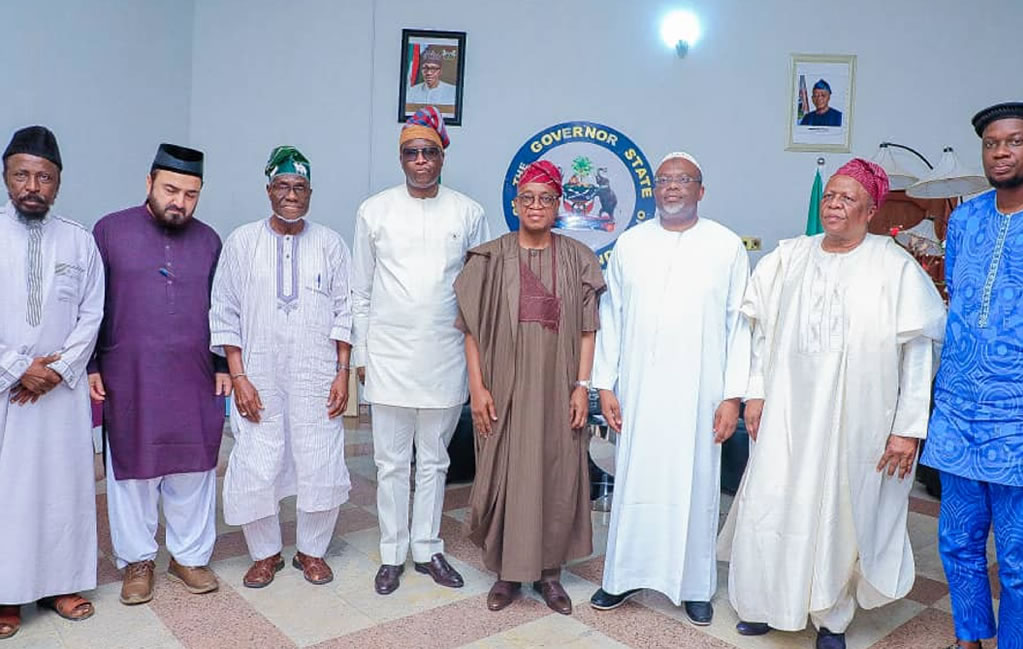
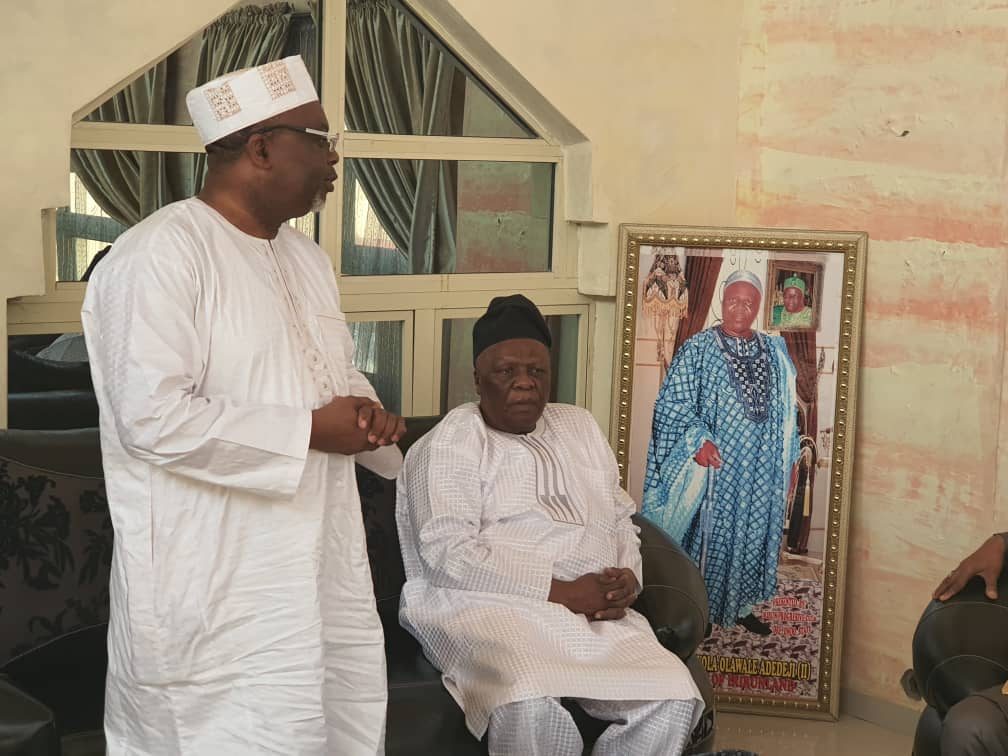
The Amir (National Head) of Ahmadiyya Muslim Jama’at Nigeria Alhaji (Barr.) Alatoye Folorunso Azeez on Monday led a delegation to pay a courtesy visit to the Executive Governor State of Osun Mr. Adegboyega Isiaka Oyetola at his official residence in Osogbo. In his speech, Barr. Alatoye felicitated with the governor for emerging the eventual winner of the State governorship election at the tribunals. He referred to the court ruling as an act of Almighty God. He also commended the governor for embarking on social and economic programmes that are beneficial to the populace since the assumption of office. The Amir further thanked the governor for his unalloyed support and cooperation in respect of Minaret International University project in Ikirun, State of Osun. Governor Oyetola was formally invited to the forthcoming Jalsa Salana (Annual Convention) of the group which will hold at Ilaro Ogun State between 20th and 22nd December 2019, and also the international convention of Ahmadiyya Community in the United Kingdom next year. In his response, Governor Oyetola appreciated the august visit and thanked the Muslim organization for their prayers and support towards the success of his administration. Recalling his long-standing relationship with Ahmadiyya Community right from childhood, the governor disclosed that the Community is a peace-loving organization that spreads the peaceful message of Islam around the globe and engages in humanitarian services which also cut across education and health sectors. The governor vowed to always give full support to the Muslim organization especially on its laudable projects within the state and also promised to attend the Nigeria Jalsa Salana as well as the international convention in the U.K. Other members of the delegation include the Missionary In-charge Maulvi Afzaal Ahmad Rauf; immediate past Amir AMJN Dr. Mashhud Adenrele Fashola; General Secretary Alh. Abbas Iromini; National Secretary External Affairs Alhaji Hassan Sunmonu; the Akirun of Ikirun Oba Olawale Olayiwola Adedeji II and Alh.(Tpl.) Bosun Akinde.
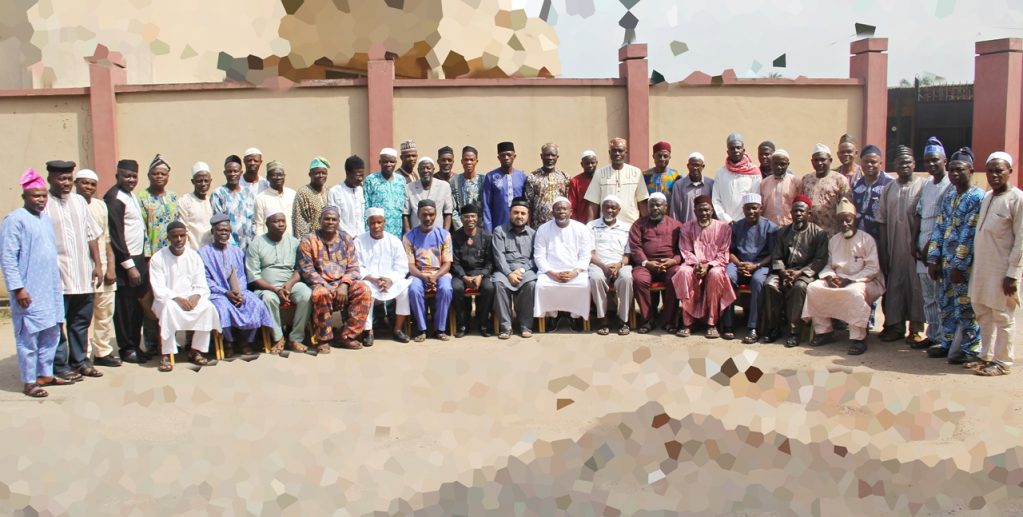
The Amir Ahmadiyya Muslim Jama’at Nigeria, Alhaji Alatoye Folorunsho Abdul Azeez held a meeting with the Circuit Presidents at National Conference Hall Ojokoro Lagos.
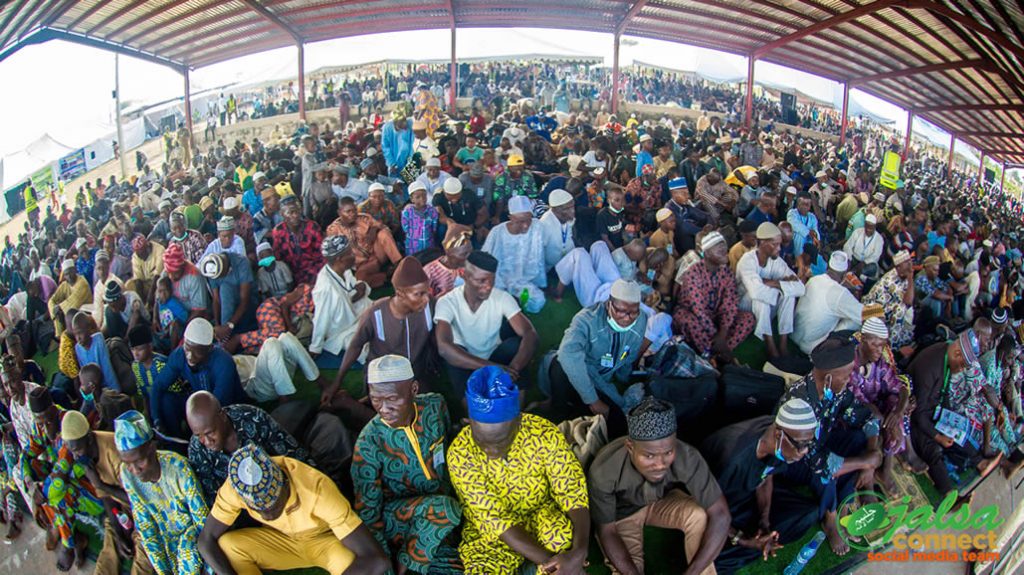
The long-awaited Jalsa Salana started and ended with thanks to Allah, with a population of thousands of people who came from far and wide, within and outside the country. Many may think that after these three days of spiritually uplifting lectures, Darood on the Holy Prophet (saw), prayers and congregational Tahajjud, we only head home and wait till the next Jalsa before we come together for such again. Now the question is: Is the Jalsa really over? Even when it is glaring that the Jalsa has ended, members and non-members should have it in mind that physically the Jalsa has ended but spiritually it has not. It is our duty and responsibility to work on the lectures delivered at the Convention instead of allowing the knowledge to waste. The theme of the just-concluded Jalsa is “EFFECTIVE WAYS OF CALLING PEOPLE TO ALLAH”. Several lectures relating to this theme were delivered by respected scholars of the Jama’at. An example of such lectures delivered is “Tabligh: A divine responsibility upon every Muslim”, quoting the verse of the Holy Quran to buttress this point (Q 5:68) “O, Messenger! Convey to the people what has been revealed to thee from thy Lord; and if thou do it not, thou hast not conveyed His message at all. And Allah will protect thee from men. Surely, Allah guides not the disbelieving people”. Two of the topics delivered are: “Exemplary Devotion in the Field of Tabligh: The Models of Hazrat Musab bin Umair (rd) and Hazrat Ghulam Rasul Raji Ki Sahib (rd)” and “Propagation of the Message of Islam using Modern Resources”. Looking at the above-mentioned topics, it is important to note that the point mostly emphasized is “TABLIGH”. Now, as Ahmadis what is our plan for Tabligh? How well do we intend to increase the number of new converts coming into the fold and how do we intend to carry out this task of Tabligh? Just as Allah the Almighty says: And who is better in speech than he who invites men to Allah and does good works and says, ‘I am surely of those who submit?’ (41:34) The act of Tabligh does not compulsorily lie with the missionaries alone but all members of the Jama’at: teachers, doctors, lawyers, engineers, nurses, entrepreneurs or whatever profession you are into, calling people to Allah does not stop you from achieving your personal goals. Now that the internet has gone a long way to bring people from far and wide together, members can make use of this tool as an effective way of doing Tabligh. It is pertinent to note this point that Huzoor (atba) has instructed the Amir Sahib to get at least a thousand Bai’at within a stipulated time, as we all know this cannot be achieved except with our active cooperation. May Allah enable us to discharge this duty as expected. Ameen
As current affairs in Nigeria show, there is no doubt that the state of the nation is at a critical crossroads. From the lingering challenges of state and human security to the persisting issues of political economy, the rising uproar about alleged regional marginalization and the call for restructuring for a true federalism, the crises of electoral politics, the spate of corruption, unemployment and poverty, and the conflict of ethnic and religious identity and expression etc., Nigeria is presently facing challenges that are combining to threaten and bedevil the corporate political, economic, social and religious existence of the country and her citizens. Without underestimating the criticality of each of the aforementioned myriads of challenges, this piece focuses on addressing what it views as the tragedies of religion in Nigeria – the monsters of Islamomania and Islamophobia – which have been eating deeply into and dividing and destroying the fabrics of the individual and corporate existence of Nigerians. Of course, the primacy of addressing religious issues in Nigeria should be easily informed by the fact of the centrality of religion in every ramification of the personal and corporate existence of Nigerians, and particularly, the divisive and destructive impacts religious crises have always had upon the country. In his Ethno‐religious Identity and Conflict in Northern Nigeria (2010), Eyene Okpanachi, making reference to Smyth and Robinson (2001), opined that “Nigeria is usually characterized as a deeply divided state in which major political issues are vigorously and or violently contested along the lines of the complex ethnic, religious, and regional divisions in the country.” This is understandable. For, as a December 18, 2012 report conducted by Pew Research Centre shows, 97.2% of the population of Nigeria is under the grip of religion. More instructive is I. Enwerem’s assertion in his 1995’s A Dangerous Awakening – The Politicization of Religion in Nigeria (published by IFRA, Ibadan) that, “religion has always been important in Nigeria and in Nigerian politics.” In fact, Paden J. once aptly declared in his Faith and Politics in Nigeria (2008) that, “the intensity of religious identity in Nigeria is regarded as one of the highest in the world.” Evidently, Paden’s claim is supported by the fact that as Eyene Okpanachi again opined, “Nigerians are more likely to define themselves in terms of religion than any other identity. Indeed, according to the authoritative May-June 2006 survey conducted by the Pew Forum on “Religion and Public Life”, 76% of Christians say that religion is more important to them than their identity as Africans, Nigerians or members of an ethnic group. Among Muslims, the number naming religion as the most important factor is even higher (91%).” Proceeding with the thrust of this piece, in simple terms, this writer views Islamomania as expressive of the psychological state of the narrow-minded, hardliner, extremist Islamists who digest Islam like opium with an unbridled poise to express and preach the religion or introduce and enforce its Sharia Law upon others in a rather radical, fanatical, coercive and do-or-die manner. On the other hand, Islamophobia connotes non-Muslims’, particularly Christians, irrational and unfounded fear of, prejudice against and hatred for Islam and Muslims. Apparently, the twain phenomena represent aberrant psycho-social complexities that have become deeply rooted in the psychological perception and empirical expression of or reaction against Islam by some elements in Nigeria over the decades, with an increasing proportion in recent times. Evidently, as both the past and ongoing trends have shown, whether it was the Muslims’ Maitatsine crisis that resulted in over 2,000 loss of life in the 1980s, the bloody crises of Sharia introduction that trailed Nigeria’s return to democratic dispensation in 1999, the menace of Boko Haram insurgency that has claimed the lives of tens of thousands and internally displaced over two million Nigerians, the instances of angry outbursts, and sometimes violent reactions, against the legitimacy of the Nigerian secular, democratic system and constitution by some extremist Muslim individuals and groups, or the various cases of intra-religious theological and ideological skirmishes among Muslim individuals, sects and denominations in the country, Islam has been an object of Islamomaniac expressions in the hands of some so-called Muslim elements. While these developments may be attributed to gross misconception and misinterpretation of Islamic Scripture, Prophetic traditions and early historical events on the part of such individuals or groups, there is no doubt that they constitute sheer misrepresentation and, in fact, an immense disservice to the image of Islam. Similarly, from the side of the non-Muslims, it is apparent that whether it is the Christians’ incessant cases of prejudice against and hullabaloos over Muslim women hijab dress, the uproar over the introduction of Islamic banking system, the entrenched instances of prejudicial stereotyping of Muslims, or the recently increasing outbursts alleging an Islamization of Nigeria agenda, in reaction to various cases of political appointments by the government of the day or its participation in the Organization of Islamic Cooperation summit or the menace of herdsmen banditry, etc., Islam has continued to be a victim of Islamophobic perceptions and reactions by non-Muslim Nigerians. Disturbingly, these phenomena (in a country where unholy romance between religion and politics has seen constant politicization of religion and religionization of political issues) have not only continued to heat up the Nigerian socio-religious space but are increasingly turning the country into a hotbed of catastrophic intra/inter-religious and socio-political suspicion, mistrust, clashes and commotions, resulting in the threat against national solidarity, coherence and unity of the country as well as socio-political and religious peace, harmony and security of life and the State. Expediently, with the deepening inter-religious suspicion and mistrust and the rising socio-religious and political tensions in the country, if we must reconstruct Muslims’ expression of, and non-Muslims’ reaction to, Islam as a socio-political and religious ideology; if the Nigerian government and people are genuinely desirous of uniting the various religions and ethnicities under a harmonious socio-religious co-existence; and if the government must ensure the security of the state and its people and save human lives from carnage, public infrastructure from destruction and Nigeria’s political solidarity and sovereignty from collapse, then the issues of
Netflix has recently released a new series – ‘Messiah.’ The lead character appears to be a religious leader or prophet-like figure who emerges from the Middle East and is referred to by some characters as Al-Masih (the Messiah). Al-Masih performs miracles of various sorts but his arrival coincides with a series of environmental disasters accompanied by ensuing havoc and violence. As he gathers followers, a CIA agent ‘must race to unravel the mystery of whether he really is a divine entity or a deceptive con artist capable of dismantling the world’s geopolitical order.’ The series has provoked controversy and debate, especially amongst Muslims and Christians. Some Muslims have pointed out that to refer to the lead character of the series as Al-Masih (the Messiah), is to use the name by which the ‘Dajjal’, or Anti-christ, will announce himself when he appears in the latter days. Others have been outraged and described the series as offensive, blasphemous and disrespectful. A change.org petition has been launched as well describing the show as “evil and anti-Islamic propaganda.” The creator, Michael Petroni has commented that he “doesn’t set out to offend anyone,” and goes on to say that, “there is going to be a lot of noise around the show and a lot of debate. I’m hoping for debate.” It is said that the purpose of this new series is to “imagine how modern society would react if such a figure appeared.” Netflix describes this as “a provocative and suspenseful thriller that explores the power of influence and belief in the social media age.” The new Netflix series ‘The Messiah’ has provoked the sentiments that surround it by religious followers who believe in the second coming of the Messiah and who hold that when the Antichrist (or Dajjal) emerges, the ‘Mahdi’ would fight him in an ultimate battle between good and evil. Let us breakdown the true nature of these concepts of the ‘Messiah’, ‘Mahdi’, and ‘Dajjal’ (Antichrist). Given the confusion, it is helpful to clarify some of the terms being used and what they really represent. So who is the Messiah? Muslims believe that Jesus (as), the Messiah, will appear in the latter days according to the prophecies of the Founder of Islam (sa). An overwhelming majority of non-Ahmadi Muslims believe that he physically ascended into the heavens after his Crucifixion and so he will physically descend from the sky in the latter days, with his hands on the shoulders of two angels. They believe that the Messiah will then join forces with the Imam Mahdi and wage a bloody war against the disbelievers until they convert to Islam. As a result, the Muslims would become kings and rulers. The fact of the matter is that this grossly disfigured view of Islam couldn’t be further from the truth. It is neither supported by the Holy Quran, nor the words of the Prophet of Islam (sa). Religious adherents throughout the ages, have always enjoyed fantastical stories of people flying up into the heavens, and returning again, and overturning the world in their favour through magic spells and bloody wars, but this has never materialised in the past, nor will it in the future. Firstly, Jesus (as), who was a prophet of God, did not physically ascend into the heavens, and so it naturally follows that, he will not descend physically in the latter days either. The Holy Quran categorically states in chapter 5 verse 118 that after Jesus (as) died his natural death, God was a watcher over his people. There is mention in Islamic literature and various source texts of the ‘descent’ of Jesus (as) in the latter days but the Arabic word ‘nuzul,’ which is used for ‘descent,’ refers to the coming of a great blessing of God Almighty, which as if, is a grace that descends from the heaven. In the Holy Quran, it is said that iron and cattle ‘descended’ from on high, and of course, all this means is that these are immense blessings of God, by which humanity benefits immensely; it does not mean that these things physically came down from the sky. Secondly, it ought to be noted that when the Holy Quran, which is considered to be the word of God, vouchsafed to the Prophet of Islam (sa), that the Jesus (as) would die a natural death. So it is obvious that prophecies which refer to his coming in the Latter Days must be understood in a metaphoric and spiritual context. The fact of the matter is that in light of the Holy Quran and the sayings of the Prophet of Islam (sa), the true Messiah who would appear in the latter days, would be a man that would appear as a spiritual manifestation of Jesus (as). He would be a prophet of God and possess a disposition that was similar to that of Jesus (as) and would heal the world from the wounds of sin and evil with his Messianic qualities. Who is the ‘Imam Mahdi?’ Non-Ahmadi Muslims believe that the Imam Mahdi will appear from among the Muslims in the Latter Days and join forces with the Messiah . Together they will literally rid the world of Christianity, breaking every Cross around as well as ridding the world of its pig population! In the havoc and chaos that this bloody Mahdi would bring, everyone would also convert to Islam. This is clearly nothing more than the fabrication of warmongering clerics who incite the masses to serve their own vested interests. There is a saying of the Prophet of Islam (sa) recorded in a Hadith (saying of the Holy Prophet Muhammad (sa)), which states that when the Messiah appears in the latter days, he would put an end to religious wars. Further, the Holy Quran clearly states that there should be no compulsion in religion (2:257). So any notion about the coming of a bloodthirsty Mahdi or Messiah is diametrically opposed to the teachings of Islam. Just one of countless examples from early Islam can demonstrate this. When the Holy Prophet
Narrated by Syed Mir Mahmud Ahmad Nasir Sahib, son-in-law of Hazrat Musleh-e-Maudra. Al Hakam is grateful to Syed Mir Mahmud Sahib for sharing his personal recollections of a great Syed Mir Mahmud Ahmad Nasir A personal problem Aside from many other reasons, it is difficult to say anything about Hazrat Musleh-e-Maud, may Allah be pleased with him, because he was a universe in himself and an ocean of knowledge. I remember his great personality and become anxious as to whether I can even describe him adequately or whether I will be able to explain his characteristics completely and draw a sufficient sketch in the minds of readers and listeners. Given the situation, how can a person express such a vast, diverse and deep personality? This is a hurdle and I think that I will not be able to fulfill the responsibility of this article. Once, I reached for a notebook to write something, but I was not able to do it. One of the reasons was that I was afraid that I would not be able to fully introduce a great being like him. Another reason was that I could not stop my tears when remembering the compassion and kindness of his majestic personality. A personal hindrance in writing is that though I have seen Hazrat Musleh-e-Maudra myself, I have also heard a lot of things in the house from my elders over an extended period of time. Verbal accounts are equally important, but I am afraid that when people hear them from me, they will start considering them as my eyewitness accounts. Careful consideration of the narrated accounts is very necessary. In response to a man’s query about Hazrat Musleh-e-Maudra while I was serving in the United States, I said that I had not witnessed any prophet with my material eyes, but the closest person I had seen to a prophet was Hazrat Mirza Bashiruddin Mahmud Ahmadra, whom I observed closely. Love of God Regarding Hazrat Musleh-e-Maud’sra love for his Lord, I would say that people do remember God, but at times, they tend to forget Him. However, Hazrat Khalifatul Masih IIra states: سوؤں تو تجھ کو دیکھ کر، جاگوں تو تجھ پہ ہو نظر موت سے تھا کسے دریغ، اُس کا ہی انتظار تھا “I go to sleep looking at You [God] and when I wake, You are my focus. I am not reluctant to die because am waiting for death [so that I may meet You].” (Kalam-e-Mahmud, p. 182) Some people used to call Hazrat Musleh-e-Maudra a prophet owing to their innocence or deep affection for him. For instance, Chaudhry Ghulam Sarwar Sahib, who belonged to Sialkot, used to say that Hazrat Musleh-e-Maudra did not call himself a prophet because of his humility, but people should call him a prophet. I [Syed Mir Mahmud Ahmad Nasir Sahib] have also heard one such incident that listening to similar discourses, Hazrat Musleh-e-Maudra said, “Some people call me a prophet, but I am certainly not a prophet,” but after a short pause he stated, “I wonder whether the love of God I have in my heart is somehow less than that of prophets?” He had a yearning for attaining God’s love. Though I am not an eyewitness, I have also heard another incident that occurred in Qadian. Once, Hazrat Musleh-e-Maudra became very ill. There were frequent announcements in the newspaper and requests for prayer were made. A regular pronouncement was published by Hazrat Amma Janra that her son, Mahmudra was ill. After some time, Allah the Almighty blessed him with good health. He visited the house of Hazrat Umm-e-Tahirra for a formal meal. Food was served, but he would not eat it. In fact, he would not even pay heed towards it. His family members requested him to start eating. Then in a very unique manner, expressing great displeasure, he told his relatives upon their repeated requests, “I was sick; I was to die and meet my God I was to see Him, but you all prayed and my health was restored.” He said this due to his passion of beholding the Divine. The narrator of the incident states that he left without eating any food. Greatness and glory I will now describe a bit about the feeling people used to experience when they would see Hazrat Musleh-e-Maudra and the way they would observe him. To put it briefly, they used to experience a kind of grandeur, spiritual elevation, splendour, magnificence and dignity. It was as if a person was standing beneath a great mountain of the Himalayas and the mountain was about to come tumbling on them. However, looking closely, people would be filled with the certainty of affection, compassion, benevolence and kindness. This is not just my personal impression, rather just as has been said [to the Promised Messiahas]: نُصِرْتُ بِالرعْبِ “You have been helped with prestige”, similarly, he too had an awe-inspiring personality that was full of grandeur, glory, excellence and honour. When I imagine the pure life, prominence and magnificence of Hazrat Musleh-e-Maudra, the following verse of the Holy Quran comes to mind: الَّذِیۡ خَلَقَ سَبۡعَ سَمٰوٰتٍ طِبَاقًا ؕ مَا تَرٰی فِیۡ خَلۡقِ الرَّحۡمٰنِ مِنۡ تَفٰوُتٍ ؕ فَارۡجِعِ الۡبَصَرَ ۙ ہَلۡ تَرٰی مِنۡ فُطُوۡرٍ۔ ثُمَّ ارۡجِعِ الۡبَصَرَ کَرَّتَیۡنِ یَنۡقَلِبۡ اِلَیۡکَ الۡبَصَرُ خَاسِئًا وَّ ہُوَ حَسِیۡرٌ “… Who has created seven heavens in harmony. No incongruity canst thou see in the creation of the Gracious God. Then look again: Seest thou any fl aw? Aye, look again, and yet again, thy sight will return unto thee only confused and fatigued.” (Surah al-Mulk, Ch.67: V.4-5) For 52 years, Paighamis [otherwise known as Lahori Ahmadis] and non-Ahmadi scholars kept trying to find faults in Hazrat Musleh-e-Maudra but were unable to do so. I remember one scene vividly. I was a bit late for Friday prayer. Normally, we used to reach the mosque before the arrival of Hazrat Musleh-e-Maudra. He would come and then the muazzin would make the call to prayer. Huzoorra would wait by the pulpit and then stand up to deliver the sermon. On that specific day, I saw that the Huzoorra departed to lead